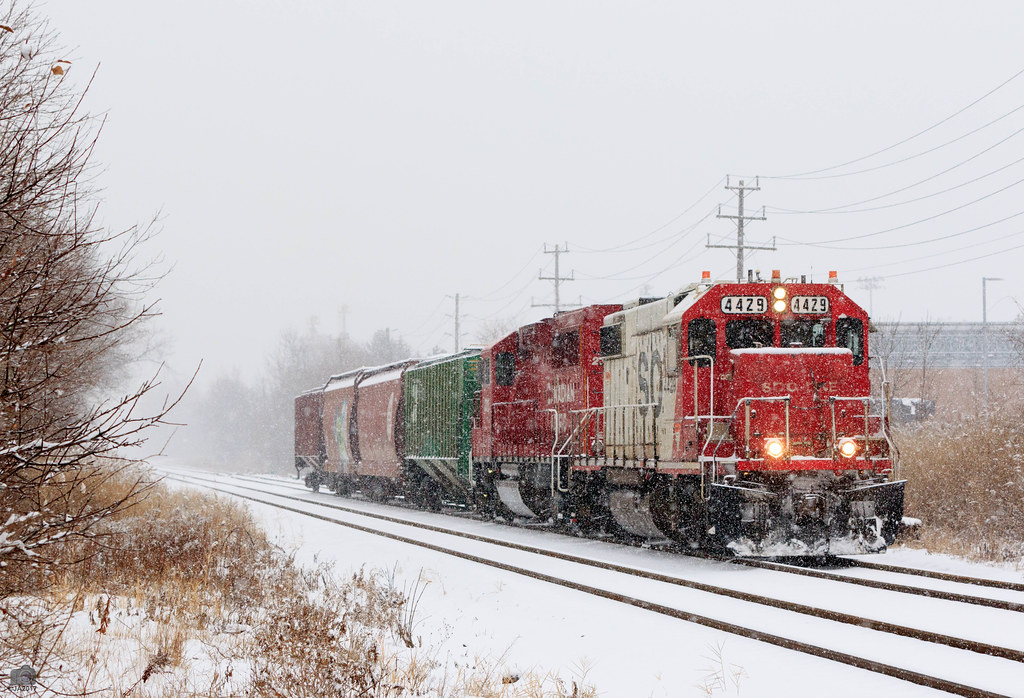
Snowy Soo

Winter Railroading.
Showing posts with label commentary. Show all posts

Thursday, 22 May 2014

What's up with no updates?

When winter recedes, I'm more likely to spend my days railfanning on my bike than layout-building in the basement. 


With the last layout update stretching back a ways now, I wanted to post and  explain why I've not posted in recent weeks.

I've not lost interest in the project. In fact, I'm feeling pretty good about the progress made and lessons learned so far. I wanted to get back into the hobby by building a simple, small switching layout that is prototype-based and enjoyable to operate and I'm well on my way to doing that.

But after a long, unrelenting winter, the good weather has arrived here in Ontario and when that happens, I turn my attention to outdoor activities with my family.

The following statement may be blasphemy to many of you, but here it is: For me model railroading is largely a seasonal pursuit, a way to spend the winter hours that doesn't involve looking into some kind of screen.

I do expect to do an update in a few weeks, one that wraps the progress made over the winter months and outlines the goals for the next year. But after that, expect the posts to tail off a bit, at least until the cold weather returns. And that will surely happen before I'm ready for it.

Thursday, 15 August 2013

The allure of modular model railroading


As a member of a modular club, I would only be "partly" responsible if the layout is terrible!
Having only recently made my re-entry into this hobby, I’ve not yet had a chance to actively pursue becoming a member of a model railroad club. I’m sure it’s great to share the hobby with others, but on Internet forums I often hear complaints about the challenges of being a club member.

Many report struggles with other members who are overly rigid about the adherence to a particular prototype, strict layout standards, etc. At the other end of the scale, others complain about members who are too flippant in their approach to modeling. It seems most club members have experienced at least some level of squabbling, difficult personalities and political infighting.

I’m sure most of you know how this goes. One member wants to model the transition era of a specific railroad; the other wants the rules relaxed so modern diesels can run alongside steam locomotives (including an HO version of Thomas the Tank Engine). Some members want a longstanding club to make the switch to DCC; others don’t see the sense in spending money to replace a block control system that’s worked well for years.

Almost any group, in any hobby, experiences these kinds of issues. It’s hard, if not impossible, to get a group of people who all want to row the boat in the same direction at all times.

This is partly what makes modular model railroading so appealing to me. You’re still part of a group, still get to run trains and share the hobby with others, but you’re also free to do what you want with your little bit of the layout (within the design standard parameters of course).

You can model as much or as little as you want, see and learn from what others have done and when the day’s done, your layout comes home with you (in most cases). Any interpersonal annoyances are minimized because you don’t have to iron out the intricacies of layout planning with three dozen other people.

Like anything, there are tradeoffs. My sense is that it’s more difficult for a modular club to achieve the same level of realism as a permanent club layout whose members have all agreed to put their collective efforts toward recreating a particular prototype.  Take the Waterloo Region Model Railway Club as an example. Although based in southwestern Ontario, the club models Canadian Pacific operations in Northern Ontario in the 1970s. I’ve not seen the layout myself but the results look amazing on the club’s website.

Obviously every member has agreed to this plan and as a statement on the club’s website explains, the adherence to such a specific prototype has actually helped the membership avoid infighting.

“By choosing a specific prototype, no one individual or internal group could determine what the WRMRC will or will not model, because the prototype railway has already dictated how it must be done,” reads the statement. “The decision to model a prototype freed us from a lot of undesirable politics, and united us towards a common goal.”
Interesting. Still I’m keen on checking out an HO scale modular club, which I also think better suits my (rather limited) skills as a modeller. There doesn’t appear to be one in Toronto proper, but if anyone knows of one or is interested in talking about it, please email me at back.on.track@bell.net.

As for my layout .... I've got track and wiring to complete and only recently addressed a pressing wire shortage, which was holding up progress. Update soon.


Wednesday, 7 November 2012

Model railroad publications


Three issues for just $2 at a train show. You can't beat that. 

Getting my hands on a copy of Model Railroader was key to sparking my early interest in the hobby all those years ago. It showed me what was possible in model railroading, even though I lacked the skill, space, money (I could go on) to make it possible. I loved reading the how-to articles and imagining how every project would unfold. 

With my return to the hobby, I’ve returned to Model Railroader and found it hasn’t lost its quality in the years I’ve been away. It seems now to be targeting less experienced modelers than it was back in the 1980s. This suits me fine.

A few weeks ago I picked up a few dozen recent issues at the Woodstock Model Train show. Vendors were selling three issues of MR for $2, a price I couldn’t resist! Now I’ve got many evenings worth of enjoyable reading for the price of a few books.

Of course, I’m sure MR is struggling somewhat, as all publications are, to remain relevant in the Internet age. Model Railroad Hobbyist is an excellent online magazine that offers all its content, including back issues, for free. 

So far Model Railroad Hobbyist appears to be making their way on advertiser support alone. You have to wonder if they will ever move to a paywall structure as many Canadian newspapers are now doing. I hope both publications are able to survive and thrive, as they play a key role in the success of this great hobby, inspiring a new generation of modelers as I was inspired all those years ago.

Wednesday, 17 October 2012

Choosing a DCC system: don't get caught up in the hype


With DCC, you're controlling the locomotive directly, instead of power to the track.


In previous posts I’ve mentioned that I have a few boxes of model railroad stuff from when I first got started in the hobby as a kid. I can’t remember exactly what those boxes contain and I won’t know for sure until I return to my parents house in British Columbia and crack them open. It’s like a model railroading time capsule! I know much of what’s in there is crap: cheap Tyco rolling stock with horn-hook couplers, brass track, one of those “loaf of bread” tunnel forms, etc. But I also happen to know there’s some good stuff in there as well. A few pieces of Athearn blue box rolling stock and locomotives with Kadee couplers, some nickel silver track, some good model railroading books and a very good DC throttle, the Tech II Dual Power model you see below:

One of these has sat in my parents basement for years. Will it still work?

Now I’m sure most readers have heard of Digital Command Control (DCC), an innovation that has come to the hobby in the years I was away. There’s loads of info on the web about DCC so I won’t go into too much depth here but essentially it allows the operator to easily and independently run locomotives without chopping up the track plan into separate electrical blocks. Instead of controlling power to the track, you are controlling each individual locomotive

I operated my old layout in pre-DCC days, using the throttle you see pictured to the right and separate electrical blocks operated with cheap (but reliable) Atlas selector switches.

This DC-with-blocks type of configuration works okay but it requires a lot of wiring and with more than one operator, someone always seems to run their train into the wrong block. With DCC you don’t have to worry about this, you can have two locos running along the same stretch of track each controlled by a separate throttle. And you can achieve this with very simple wiring.

Now at first I considered operating my layout with the old Tech II and my DC engines. After all, this layout will almost never have more than one operator working at a time and there is an expense in buying a new DCC system plus adding decoders to the locomotives. (((An aside for those new to DCC: digital command works by installing tiny little electronic chips, called decoders, in each locomotive. These decoders allow each loco to “talk” to the command station.)))

In the end though, I decided to move ahead with DCC. Assuming it still works after 20 years in storage, I will use the Tech II to test locos, power accessories, etc.

Here’s why I went ahead with DCC:

1.   I’m impatient and I’m not sure when I can get my old stuff out of my parents’ place any time soon. They’re getting older and hauling all these boxes to the post office is a lot to ask.
2.   DCC really is the way the hobby is going (or has already gone). It’s not just one company using this technology, they are all following an industry standard where decoders made by one company can be controlled by a command station made by another, so I didn’t feel my money would be wasted.
3.   It wasn’t too costly. I bought a DCC starter set (more on that below) for about $200 delivered to my door. I remember paying more than $120 for the old Tech II, but that was back in like 1986.
4.   I’m no wiring wizard but I’ve watched enough videos and read enough articles to see that adding decoders isn’t too difficult.
5.   The ability to add sound. You pretty much have to go DCC if you want sound on your layout.


So I’m sold on DCC, now which system do I buy?


You can spend hours reading online forums, articles, etc, about the pros and cons of the various DCC systems on the market. I did all that reading and now regret that I’ll never get those hours back. The way I see it, and I know many of you will disagree, it comes down to two excellent systems: NCE or the Digitrax system.

The conclusion I came to is that both are excellent systems and the debate over which one to buy is rather like the Nikon vs. Cannon debate that often rages among photographers whose time would be better spent taking pictures.

Like the choice photographers face between Cannon and Nikon, both Digitrax and NCE are great systems, both are very expandable and both will do what 99% of what you will ever want and expect  for a comparable price. The main difference, as I see it, is that the Digitrax starter system (the Zephyr) is a stationary cab, while the PowerCab is a command station built into a walkaround throttle on a tethered cord. I realize I’m glossing over all sorts of details here but like I said, I don’t want this to be a DCC debate forum.

So what did I decide? In the end I went for the … NCE PowerCab. With taxes, delivery, etc. it arrived at my door for about $200. I bought it from local online retailer Canadian Express Line.

So why did I go with this system? I like the fact I could walk around with the throttle right out of the box. The stationary  Zephyr just reminded me too much of the DC power packs of old. Of course you could always add a walkaround throttle to a Digitrax system and be on your feet right away, but I liked that the NCE system allowed me to do this right out of the box. 

Also, I read through the manuals of both systems and the NCE just seemed more user friendly to me. Does that mean Digitrax is a bad system? No way. In fact most clubs seem to use Digitrax so if I get into modular or club railroading I may find myself regretting this decision. But what’s the worst that will happen? I sell the ProCab on eBay, buy a Digitrax system and move on. Any decoder-equipped locos will work with both systems. For now however I think I made the right choice and with the decision made, I'm looking forward to the other aspects of building this layout.

My advice to other modelers agonizing over DDC decision is this is: buy either of these systems with complete confidence. And if you’re in a club that uses one of these systems, buy the system the club uses. Then, once the decision is made, don’t look back and enjoy running trains and building your layout confident that you bought into an excellent, expandable DCC system.

In the next section I will actually have track in place and can start running trains…